
The other day I was a student in a Vinyasa class. I was in the back corner of the room when the teacher led us into a long hold of a particular twist. I was really surprised at my view as I turned and took in a row of other students. Even knowing all I know about the differences in anatomy and how that impacts our asana practice, I don’t think I have ever seen a more perfect view of how much it matters.
I could see three folks perfectly lined up, all regular practitioners in a strong form of the asana. Each of their spines were stretched tall and stacked straight over the hips. They each had about the same amount of rotation from the spine, with their right arms positioned behind them like kickstands as they gazed over their shoulders. At a glance there would have been nothing to offer any notes on. But as we held the pose, I got curious about the clear differences in what they were doing with their back hands. These three women did not have anywhere near the same proportions of arm length to torso length, and it showed.
One was up on the fingertips of her back hand. While her spine was straight, her long torso meant that even with relaxed shoulders and her back hand quite close to the hip, that hand is never going to be flat on the floor while her torso is long, engaged, and vertical. She could either round her spine or lean backwards to get there, but either of those options would go against the rest of the guidance on the shape. I’m going to skip the obvious discussion on why slouching is a hard pass.
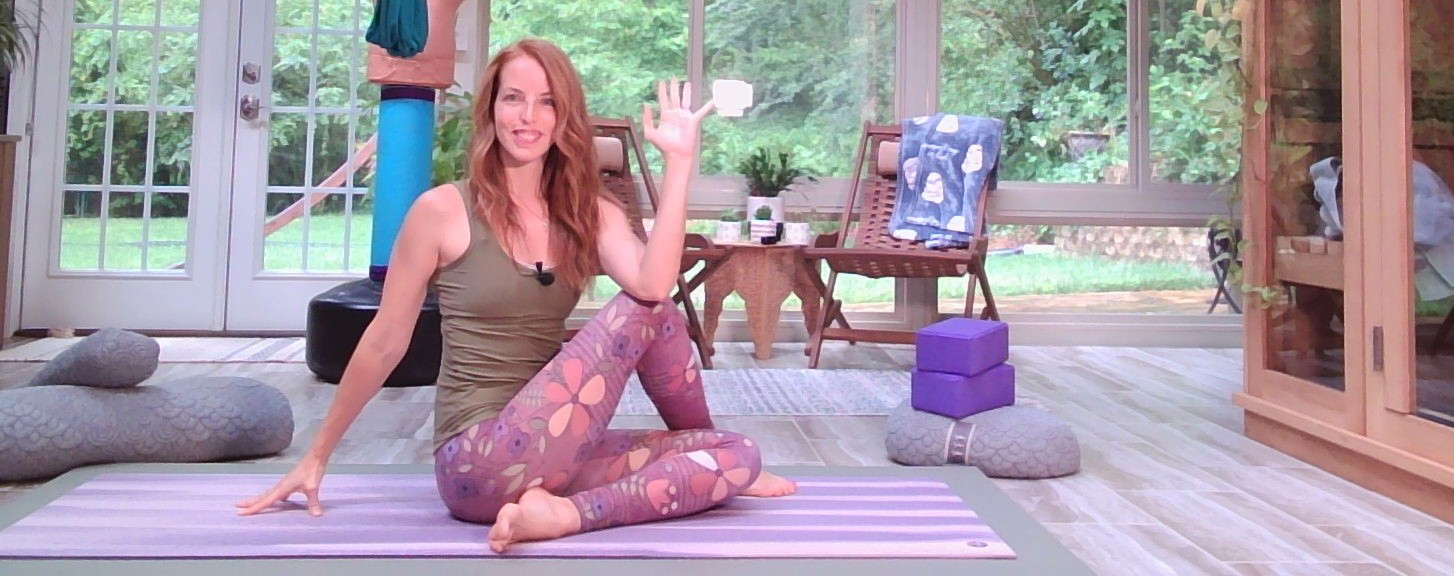
If she leaned back (among other impacts) this would take her out of balance as that hand would become actively weight bearing for her. Instead, adding a block under that hand would have given her the actual support a hand pushing down onto a firm surface provides. This would have allowed her to move from grounded stability more into the twist without sacrificing other parts of the shape. Think of it this way, if you need to twist open a jar, you are unlikely to find much strength to do so if you are only gripping the lid with your fingertips. Note – there is nothing wrong with being on fingertips (see picture above and my comments regarding this photo near the end of this blog). This student was super stable in the asana, no notes. However, if you aren’t stable or aren’t feeling the depth of twist you want, a block Is useful.
The next student had a shorter torso and longer arms. Her back arm was straight with her hand flat on the floor and positioned close to the hip, usually a ‘good’ alignment for getting length throughout the spine. However, I could see that her back shoulder was quite elevated compared to her front shoulder. Unless she leaned her torso forward (please don’t) there was no place for her to go or grow with that hand and arm position. Once the spine is stacked vertically, if you have long arms relative to torso length and your hand is flat on the floor, bending the elbow enough that the shoulders are neutral and parallel to the floor will allow you to find a lot more strength to both stabilize and deepen the twist. Bending the elbow is also a great intro to feel into the shape of the bind available here (that back arm bends and reaches around the low back towards the opposite hip). It is common for folks with these ratios to keep their back hand further out from the hip. This does help the shoulder elevation but makes it really easy to lock the elbow joint, so be cautious.
The third student had the Goldilocks blend of arm and torso length that makes the average cues and instructions work for the normalized version of this shape. It’s not always skill, sometimes it’s the luck of genetics that makes this asana look just right because we’ve likely all seen too many “perfect” yoga pictures and not had nearly as many meaningful conversations about what those photos actually document.
In the photo above I have both tented fingers and the back arm stretched out fairly far away from me. I’m stable and in a place of strength where I could have (with no notable torso changes) swept the back arm towards the bind, which is to say – that arm isn’t weight bearing for me. Take this image as a reminder that variations aren’t “bad”, it’s simply a matter of making mindful choices about where we are in our shape, what we are feeling, and what we want to be feeling in the shape. In this case, tented fingers keep me from leaning weight into my hand so I could focus on using my core to do the lifting and supporting. Also, what you can’t really see because of the angle of the photo is that my back arm is a bit bent at the elbow. I’m getting a little deeper in the twist because my fingers are actively on the floor, but more focused on the length of my spine within the twist.
As a yoga teacher, this is the kind of stuff I ponder in my free time. If I were working one on one with each of the students above, I would give them each different cues (verbal instructions), support, and explanations. But yoga is often a group class without a huge amount of time to give this kind of very specific feedback without creating mass confusion.
What to do?
In most asanas, I choose to focus on the spine and remind students that often the arms and legs are the tools we use to move the spine, not the most critical bit of the asana. I’ll slide in blocks for folks and sometimes ask the whole class to use them because everyone can bend their elbows (and activate some arm muscles as a bonus) but not everyone can reach longer. I stay present to my students and encourage them to trust how it feels in their own body and to ask questions, because at the end of the day the student is the one on the journey to find their version of “just right” every time they step onto the mat.
Journal Prompt: In pursuing a yoga shape, we can get wrapped up in trying to get our hands someplace that we lose track of the foundational purpose of the asana. Where in your life do you feel so focused on the minutia of what that (theoretical) back hand is doing that you have lost track of your greater purpose?
Physical Prompt: The next time you are in a twist in your yoga practice, notice your back hand. Regardless of what you notice – If you’ve got a block slide it in and see what that might open up for you. If you have a wall mirror – use it to look at your spine to see if it is straight, and at your shoulders to see if they are level.
All content I share here, elsewhere on my websites and in social media is created by me, Alison Gurevich – and not AI or other sources unless otherwise specifically attributed. This includes all photographs, writing, and ideas. All rights reserved by Alison Gurevich. “Twisted up in Arm and Torso Length” originally published to www.breathtomotion.com on June 16, 2025. When you find typos or grammar errors, celebrate humanity and enjoy a little song: https://www.youtube.com/watch?v=L3wKzyIN1yk (Human by Rag N Bone Man).